By DRS Roofing of Central Florida | Updated May 2026
If you’ve landed on this page, you probably already know that national roof cost averages aren’t worth much to you. You want to know what a new roof actually costs in Orlando — not in Chicago or New York.
Fair enough. Here’s the direct answer, and then the honest explanation of why your specific number could land anywhere within those ranges.
TL;DR: A roof replacement in Orlando in 2026 costs between $10,000 and $42,000 for a standard residential home, depending almost entirely on material choice, roof size, and complexity. The most common scenario — a 2,000 sq. ft. home with architectural shingles — runs $12,000–$18,000. Concrete tile runs $20,000–$38,000 for the same size. Standing seam metal runs $20,000–$36,000. Tile tear-offs, steep pitches, rotted decking, and complex rooflines all push costs higher. Every legitimate quote includes tear-off, underlayment, permits, and labor — if any of those are missing from an estimate you received, ask why.
Why Orlando Roof Costs Don’t Match National Averages
This matters enough to address upfront, because a lot of homeowners call us after reading a national cost guide and feeling blindsided by what they’re actually quoted locally.
Orlando roofing is more expensive than the national average for several legitimate reasons:
Florida Building Code requirements are among the strictest in the country. Every roofing product installed in Florida must carry Florida Product Approval (FPA) listing — a state-specific certification that products meet hurricane wind resistance standards. Underlayment requirements are more demanding. Fastening schedules (the nail pattern used to attach shingles or decking) are stricter. These aren’t bureaucratic friction — they exist because Florida gets hurricanes, and the building code was significantly tightened after Hurricane Andrew exposed how catastrophically underprepared the industry was. The requirements add real cost, and any contractor who skips them is cutting corners that matter.
The permitting process is real and mandatory. Every residential roof replacement in Orange County requires a permit. Permit fees in Orange County typically run $300–$800 depending on the project scope. Permitted work is inspected — and that inspection is your protection as a homeowner. A contractor who offers to skip the permit to save you money is creating significant liability for you: non-permitted roof work can void your insurance coverage, create problems at resale, and leave you with no legal recourse if the installation is done incorrectly. Permits should always be a line item in your estimate.
Labor rates reflect a specialized, high-demand market. Central Florida’s population growth keeps roofing contractors consistently busy. The roofing crews working in this market have to know Florida-specific installation requirements — and the good ones do. Experienced roofing labor in the Orlando metro runs $2.50–$5.00 per square foot depending on complexity, roof pitch, and the number of specialized penetrations involved.
Climate accelerates costs in ways the national data doesn’t capture. Florida’s year-round UV exposure, humidity, and storm exposure mean that decking rot is significantly more common here than in drier climates. When we remove an old roof in Central Florida, we find damaged decking that needs replacement on a meaningful percentage of projects — particularly on homes built in the 1980s and 1990s during Orlando’s construction boom. That cost is real and can’t be quoted accurately until tear-off begins, which is why we always note it separately and get homeowner approval before proceeding.
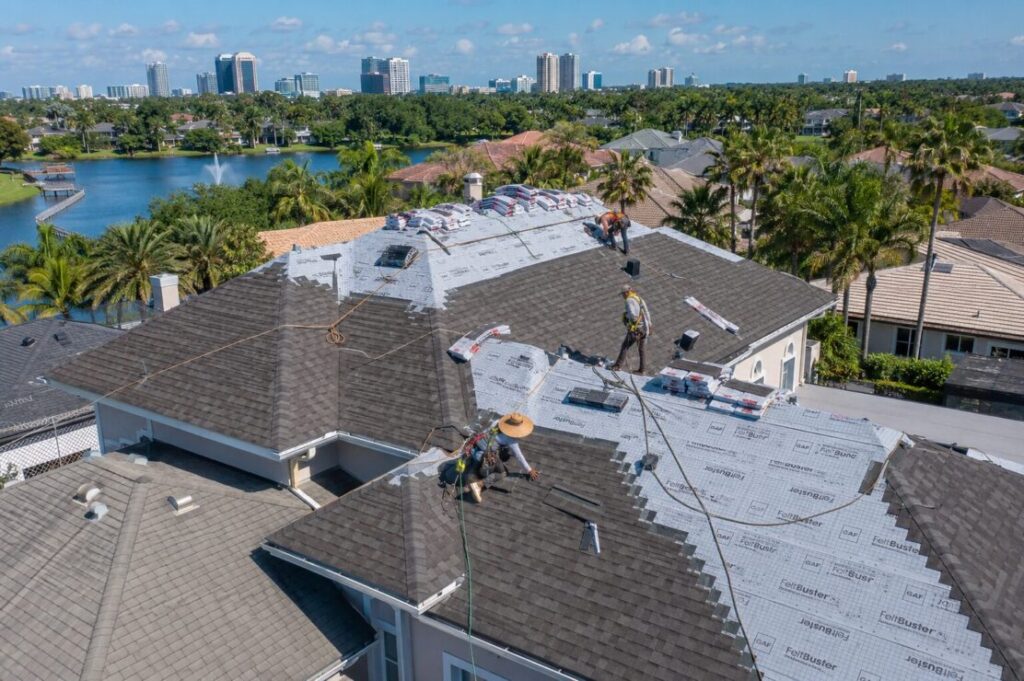
2026 Roof Replacement Costs by Material — Orlando Market
All prices below are installed costs — meaning they include tear-off of the existing roof, synthetic underlayment, materials, labor, disposal, and standard permit fees for an Orange County project. They assume a standard residential roof at moderate pitch (4:12–6:12) with typical complexity. Higher pitch, complex geometry, or decking replacement will add to these figures.
Architectural Asphalt Shingles
Architectural shingles are the most commonly installed roofing material in Central Florida, and for most homeowners they represent the best balance of performance and cost.
- Cost per square foot installed: $5.00–$9.00
- Typical range by home size:
- Small home (under 1,500 sq. ft. roof area): $8,000–$13,000
- Mid-size home (1,500–2,200 sq. ft. roof area): $12,000–$18,000
- Larger home (2,200–3,000 sq. ft. roof area): $16,000–$24,000
- Expected lifespan in Florida’s climate: 15–25 years
- Wind rating: 110–130 mph when properly installed per Florida code
- Installation timeline: 1–2 days for most residential projects
Modern architectural shingles from manufacturers like Atlas, GAF and Owens Corning offer solid wind performance and algae resistance — the latter is not optional in Central Florida’s humidity. Budget-tier 3-tab shingles are cheaper on paper but are generally not recommended for Florida’s hurricane zone because of their lower wind resistance. Every legitimate installation in this market should use architectural shingles at minimum.
Impact-resistant (Class 4) architectural shingles add $3,000–$6,000 to the above ranges but earn meaningful insurance discounts — typically 10–20% annually from carriers that recognize UL 2218 Class 4 ratings. For many homeowners, the payback period on that upgrade is 6–10 years in insurance savings alone, with the premium reducing every year after that.

Concrete Tile
Concrete tile is the dominant roofing material in many established Central Florida communities — Winter Park, Baldwin Park, Dr. Phillips, and most HOA neighborhoods built in the 1990s and 2000s were built with concrete tile as the standard. When it’s time to replace, most homeowners in these neighborhoods are replacing concrete with concrete to maintain HOA compliance and neighborhood aesthetic.
- Cost per square foot installed: $9.00–$19.00
- Typical range by home size:
- Small home (under 1,500 sq. ft. roof area): $14,000–$22,000
- Mid-size home (1,500–2,200 sq. ft. roof area): $20,000–$32,000
- Larger home (2,200–3,000 sq. ft. roof area): $26,000–$42,000
- Expected lifespan: 40–50 years
- Wind rating: 125–150+ mph when mechanically fastened to current code
- Installation timeline: 3–5 days for most residential projects
One issue specific to Central Florida’s housing stock that homeowners often don’t know: many concrete tile roofs installed during the 1980s–90s construction boom used felt underlayment rated for 20–30 years. The tiles on those roofs may still look perfectly intact. The underlayment beneath them has been past its service life for a decade in many cases. When we remove these roofs, we’re often replacing both tiles and underlayment. The new installation uses synthetic underlayment, which is the current standard and far more durable in Florida’s climate.
One additional cost consideration for concrete tile: weight. Tile is significantly heavier than shingles or metal, and a structural evaluation of your roof deck and framing is part of every tile replacement estimate. In most cases, existing structures built for tile can accept new tile without modification. Occasionally, additional support is required.
Clay Tile
Clay tile is the premium end of the tile category — it’s what you see on historic homes in Winter Park and high-end custom builds throughout Orange and Seminole counties. Clay offers exceptional longevity (100+ years in some cases) and a distinctive appearance that’s difficult to replicate with other materials.
- Cost per square foot installed: $12.00–$21.00
- Typical range for a mid-size home (1,500–2,200 sq. ft. roof area): $22,000–$40,000+
- Expected lifespan: 50–100+ years with proper maintenance
- Notes: Significantly heavier than concrete tile; structural evaluation always required. Some historic districts in Winter Park have specific profile and color requirements that add permitting complexity.
Standing Seam Metal
Standing seam metal has become a meaningful part of the Central Florida replacement market over the past several years, driven by insurance economics, energy efficiency, and the recognition that a metal roof is likely the last roof a homeowner will ever install on that home.
- Cost per square foot installed: $10.00–$18.00
- Typical range by home size:
- Small home (under 1,500 sq. ft. roof area): $16,000–$24,000
- Mid-size home (1,500–2,200 sq. ft. roof area): $20,000–$32,000
- Larger home (2,200–3,000 sq. ft. roof area): $28,000–$40,000+
- Expected lifespan: 40–70 years
- Wind rating: 140–160 mph
- Installation timeline: 3–5 days for most residential projects
Standing seam uses concealed fasteners — no exposed screws that can back out, corrode, or create leak paths over time. This is what distinguishes it from lower-cost exposed-fastener metal panels and why it’s the appropriate choice for residential replacement rather than agricultural or commercial low-slope applications.
Stone-Coated Steel
Stone-coated steel offers a middle ground between the aesthetics of traditional tile or shingles and the performance of metal. It’s increasingly popular in HOA communities where standing seam metal may not match the architectural profile requirements.
- Cost per square foot installed: $8.00–$14.00
- Typical range for a mid-size home: $16,000–$28,000
- Expected lifespan: 40–50 years

The Variables That Move Your Number
Understanding the base cost by material is only part of the picture. Here’s what actually pushes a specific project toward the high or low end of the range.
Roof Size
Roofing is priced by the “square” — one square equals 100 square feet of roof surface area. Your roof’s square footage is always larger than your home’s living area footprint because it includes overhangs, extends over garages, and increases with pitch. A home with 2,000 square feet of living area might have a roof surface of 2,400 to 3,000 square feet depending on pitch and configuration. Every additional square adds $400–$800+ in materials and labor, depending on the material.
Roof Pitch
Pitch is the slope of your roof, expressed as a rise-to-run ratio (a 5:12 pitch rises 5 inches for every 12 inches of horizontal run). Most Central Florida homes have moderate pitches in the 4:12–6:12 range, which represents the baseline labor cost.
Steeper roofs — 7:12 and above — require additional safety equipment (harnesses, roof jacks, staging), slow the installation pace due to footing challenges, and generate more material waste from angled cuts. Expect 15–25% higher labor costs on steep-pitch roofs compared to equivalent moderate-pitch roofs.
Roof Complexity
A simple gable roof with one ridge, two slopes, and a couple of vent pipes is the least expensive configuration to replace regardless of material. As complexity increases — hip roof geometry, multiple valleys, dormers, skylights, chimneys, turrets, or multiple roof planes that intersect at different angles — labor costs rise because each transition point requires custom flashing work, precise material cuts, and careful waterproofing attention.
A complex roof with eight or ten planes, multiple dormers, and two skylights can cost 15–25% more in labor than a simple gable of the same square footage. Your estimate should account for your specific roof geometry, not just a generic per-square-foot rate.
Decking Condition
This is the variable that’s genuinely impossible to price accurately before tear-off begins. When the old roofing material is removed, the plywood or OSB decking underneath must be inspected board by board for water damage, rot, delamination, and structural integrity.
In Central Florida’s climate, damaged decking is common — particularly on older homes and on any home that has had an undetected slow leak. Decking replacement typically costs $80–$120 per sheet (a standard 4×8 sheet covers 32 square feet). On a project where 10–15% of the decking needs replacement, that can add $1,500–$4,000 to the base quote. On a project with significant long-term water damage, it can be more.
Every legitimate contractor inspects decking during tear-off and provides a separate line-item quote before proceeding with any replacement. If a contractor quotes you a fixed price inclusive of all possible decking repair without having seen your roof, ask how they arrived at that number.
Tear-Off and Disposal
Removing the existing roofing material and properly disposing of it adds $1,000–$3,000 to the project depending on the material. Tile tear-offs are at the higher end because tile is heavy, labor-intensive to remove, and requires careful disposal. Shingle tear-offs run lower. This should always be a line item in your estimate — never bundled invisibly into a round-number total.
Penetrations
Every chimney, skylight, vent pipe, satellite dish mount, solar panel, or dormer on your roof adds labor cost. Each penetration requires custom flashing work, precise cutting around the opening, and waterproofing attention. A simple roof with two vent pipes is baseline. A roof with a chimney, two skylights, multiple dormers, and complex valley work adds 15–25% to the base labor estimate.
What a Legitimate Estimate Should Always Include
Before you compare quotes, know what should be in every one of them. A professional roof replacement estimate in Orlando should itemize:
- Tear-off and disposal of the existing roofing system, including dumpster placement and haul-away
- Deck inspection — identification of any damaged or rotted decking, quoted separately before proceeding
- Synthetic underlayment — the secondary water barrier installed between the deck and the surface material. In Florida, peel-and-stick self-adhering underlayment is the current standard and is required in certain conditions; a legitimate contractor won’t substitute felt to save cost
- New drip edge and flashing — all valleys, penetrations, and roof-to-wall transitions should receive new metal flashing
- Installation of the roofing system to Florida Building Code and manufacturer specifications
- Orange County permit fee — required for every residential replacement; typically $300–$800
- Final inspection and cleanup — the job isn’t done until the permit is closed and your yard is clean
If you receive an estimate that’s notably lower than others and those line items aren’t present or are bundled into an unexplained total, ask for itemization. The difference often shows up in skipped underlayment, reused flashing, missing permits, or labor costs that don’t include Florida-compliant fastening patterns.

Financing Options: What’s Available in 2026
A roof replacement is a significant expense, and most homeowners don’t have $15,000–$35,000 sitting in a checking account earmarked for it. Financing is a legitimate and common part of how this purchase gets done.
At DRS Roofing, we offer flexible financing options with low monthly payments that make it possible to address a failing or aging roof before a storm forces the issue under worse circumstances. The conversation about financing happens at the estimate — there’s no reason to delay a necessary replacement because the full cost isn’t immediately available.
It’s also worth noting that the My Safe Florida Home program remains active in 2026 with $352 million in available funding for matching grants of up to $10,000 on qualifying wind mitigation improvements, including roof tie-downs and hurricane straps. If you’re replacing a roof on a home that doesn’t currently have hurricane straps connecting the roof to the wall structure, that upgrade can be incorporated into the replacement and may qualify for grant matching. Check eligibility at MySafeFLHome.com.
How to Use This Information When Getting Roof Replacement Estimates
When you request quotes from Orlando roofing contractors, here’s how to use the numbers above productively:
Get at least three estimates. The range of quotes you receive will tell you something about the market. If one estimate is dramatically lower than two others, ask specifically what’s different — material grade, underlayment type, whether decking replacement is included, and whether the permit fee is in the number.
Compare line items, not totals. A $13,000 quote and a $16,000 quote aren’t directly comparable unless you know what’s in each one. The $3,000 difference might be legitimate — different shingle product, different underlayment — or it might be missing permit costs, thinner underlayment, or cut corners on flashing.
Ask about the warranty structure. There are two warranties on every roof: the manufacturer’s materials warranty (typically 25–50 years depending on product and registration) and the contractor’s workmanship warranty. The workmanship warranty is what covers installation errors — leaks, improper flashing, fastening issues. Ask how long it is and what it covers.
Verify the license. Every Florida roofing contractor must be licensed by the state. You can verify any Florida contractor’s license at myfloridalicense.com. A valid license number should appear on every estimate you receive. DRS Roofing’s license is #CC-C057239.
How much does it cost to replace a roof on a 2,000 square foot house in Orlando?
For a 2,000 square foot home, the roof surface area is typically 2,400 to 2,800 square feet accounting for pitch and overhang. With architectural shingles, expect $12,000–$18,000 installed. With standing seam metal, expect $20,000–$32,000. With concrete tile, expect $20,000–$35,000. These figures include tear-off, underlayment, permit, labor, and disposal — all of which should appear as line items in any legitimate estimate.
How long does a new roof last in Florida?
Florida’s climate shortens roofing lifespans compared to national averages. Architectural asphalt shingles typically last 15–25 years in Central Florida. Concrete tile lasts 40–50 years. Standing seam metal lasts 40–70 years. The combination of UV intensity, year-round humidity, and hurricane-season wind exposure is harder on roofing materials than most other U.S. climates — which is why material choice matters more here than it does in drier or cooler markets.
Can I finance a roof replacement in Orlando?
Yes. Financing is a common and practical way to handle a roof replacement, and most reputable Orlando roofing contractors offer financing options. DRS Roofing offers flexible financing with low monthly payments. It’s also worth checking eligibility for the My Safe Florida Home program, which offers matching grants of up to $10,000 for qualifying wind mitigation improvements that can be incorporated into a roof replacement project.
Does homeowners insurance cover roof replacement in Orlando?
It depends on the cause and your policy terms. Florida homeowners insurance generally covers roof damage caused by a sudden, covered peril — wind, hail, a falling tree — but does not cover replacement due to age, wear, or neglect. If your roof is older, your policy may pay actual cash value (ACV) rather than full replacement cost, meaning depreciation is deducted from the payout. Always review your policy before a storm, not after.
Do I need a permit to replace my roof in Orlando?
Yes. Every residential roof replacement in Orange County requires a permit, and the work must pass inspection before the permit is closed. This is not optional, and any contractor who suggests skipping it is creating serious liability for you — unpermitted roof work can void your insurance coverage and create problems when you sell the home.
The Bottom Line
A roof replacement in Orlando is a significant investment — and an important one. It protects everything inside the home, directly affects your homeowners insurance costs and coverage, and in Florida’s climate, it works harder than almost any other structural element of the house.
The numbers above give you a real framework for evaluating what you hear when estimates arrive. What they can’t replace is a licensed contractor actually looking at your specific roof — its size, pitch, condition, and complexity — and giving you a written, itemized quote.
If you’d like that conversation, we’re ready to have it. Our inspections are free, our estimates are detailed, and after more than 30 years in this market, we know how to give you a straight answer about what your roof needs.
Call DRS Roofing (407) 240-1225 or request your free inspection online.
DRS Roofing of Central Florida has served Orlando homeowners and businesses since 1995. Licensed roofing contractor, License #CC-C057239. Members of FRSA and CFRSA. All cost figures are based on 2026 Central Florida market data and represent typical installed costs for permitted, code-compliant residential roof replacements. Actual costs vary by project. A written estimate from a licensed contractor is the only accurate way to determine your specific cost.